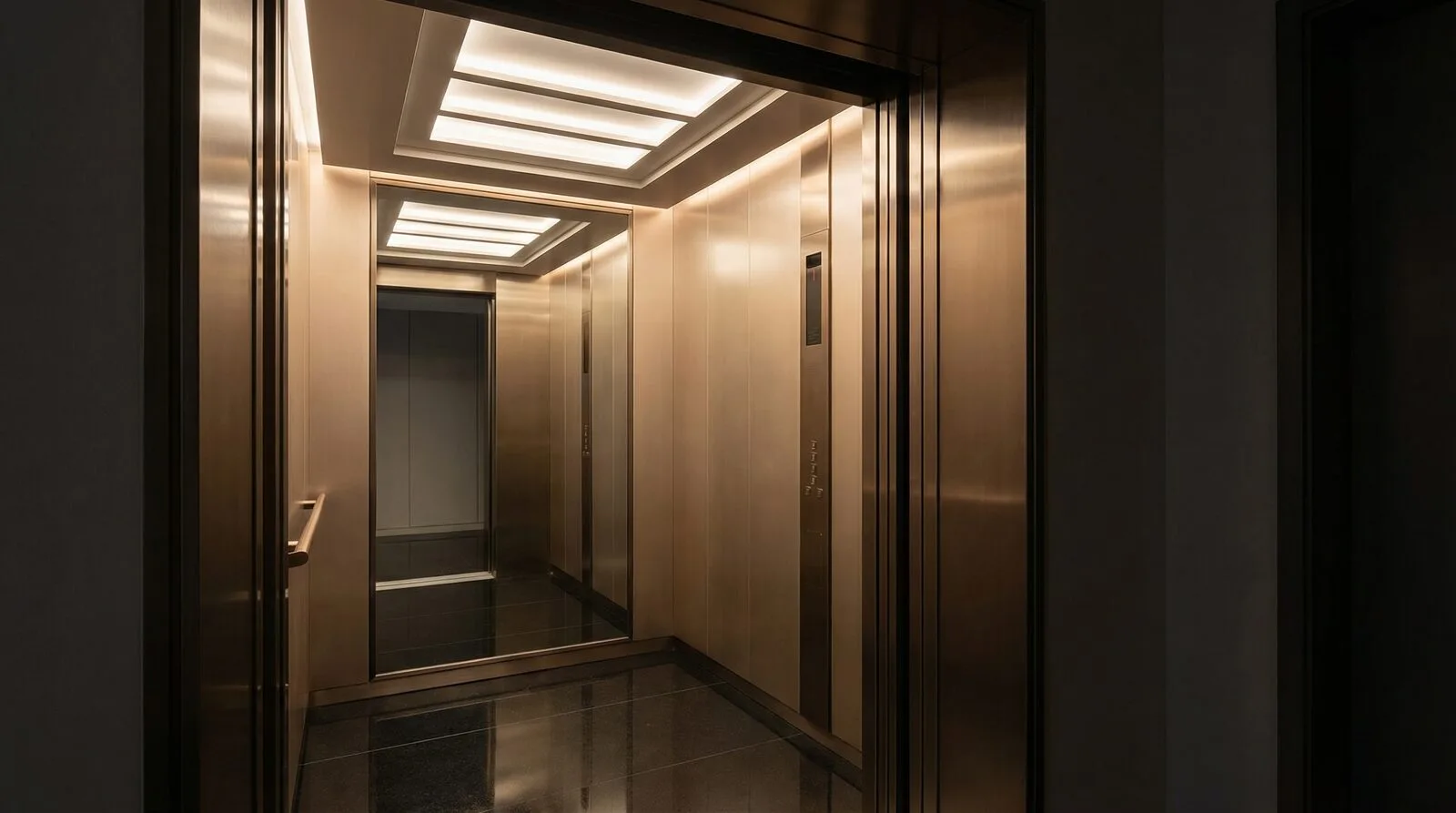
What is a platform lift?
A platform lift — also called a vertical platform lift, wheelchair lift or, in homes, a through-floor lift — is a lift designed first for people with impaired mobility. It carries the user on a level platform, usually inside an enclosure with doors or gates at each floor, and travels vertically along guided rails. Because it runs slowly and has its own safety standard, EN 81-41, it is regulated as machinery rather than as a conventional passenger lift (which sits under EN 81-20 and the Lifts Directive). That regulatory difference is the reason a platform lift can be fitted into an existing home, shop or office in days rather than weeks. Our platform lift vs passenger lift guide sets the two side by side.
How does a platform lift work?
Every platform lift has four parts: a drive that moves the platform, a guided structure it travels on, an enclosure or guarding that keeps the user safe, and a control system. In the UK market the drive is one of three types:
- Screw drive — a threaded screw runs the height of the mast and a rotating nut on the carriage climbs it. Simple, but the motor sits in the tower and runs the full journey.
- Hydraulic drive — a pump pushes oil into a ram (piston) to raise the platform; lowering is by controlled release, so descent uses almost no power. Quiet and smooth, and the power unit can sit at the base.
- Chain, belt or rack-and-pinion drive — a motor and gearbox at the top of the mast drive a chain, toothed belt or pinion along a rack.
The OnLevel lift is hydraulic: an indirect-acting hydraulic piston with a 2:1 ratio lifts the platform via 9mm steel traction cables, so the ram travels half the distance the platform does and the whole unit fits inside the self-supporting tower. The 2.2 kW power unit runs from a standard 220V single-phase household supply — no three-phase upgrade — and operation is under 70 dB(A), quieter than a normal conversation. The self-supporting, bolted steel frame carries its own running loads to a 150mm recess, which is why no shaft or machine room is needed; our shaftless lifts guide explains that structure.
Speed, controls and safety
| Feature | How it works on a platform lift | Why it matters |
|---|---|---|
| Speed | Up to 0.15 m/s (OnLevel: 0.15 m/s constant) | The EN 81-41 limit; a two-floor journey takes around 20–30 seconds |
| Controls | Constant-pressure buttons — the lift moves while the button is held and stops when released | The user is always in control; no trapped-in-motion scenario |
| Enclosure | Enclosed car or guarded platform with interlocked doors or gates at every landing | Doors cannot open unless the platform is level at that floor |
| Edges and floor | Sensored platform edges; platform stops flush with the finished floor | Level entry for wheelchairs, no trip lip |
| Power cut | Battery emergency descent to the nearest floor | Nobody is left between floors |
| Communication | Two-way phone or GSM link and a battery-powered alarm | Help is one button away, as EN 81-41 requires |
Vertical platform lifts, step lifts and inclined platform lifts
The phrase covers three different products, and buyers often search for one while needing another:
- Vertical platform lift (enclosed) — the full home and commercial product: an enclosed car travelling up to 15 metres and six stops through floor apertures or in a lightwell. This is the OnLevel through-floor and commercial lift, with a platform from 850 × 850mm up to 1400 × 1600mm and a rated load of 250–400kg (up to five people).
- Short-rise vertical lift or step lift — an open or half-height platform for a few steps or a split level, typically up to about 3 metres of travel, often surface-mounted with a ramp instead of a recess. The compact OnLevel step lift carries 300kg on a 950 × 1250mm platform.
- Inclined platform lift (stairway platform lift) — a platform that travels along the staircase on a rail, like a stairlift that carries a wheelchair. Useful where there is no footprint for a vertical lift, but slower, heavier on the stair structure and usually needing a wide, straight flight.
Where the building allows it, a vertical lift is normally the better answer: it keeps the staircase clear, serves every floor and is the option occupational therapists usually recommend for a full-time wheelchair user. Our wheelchair lifts guide compares the options in more detail.
Where platform lifts are used
Anywhere a step or a staircase stops someone: two- and three-storey homes (through-floor lifts), flats and maisonettes, shops with a stockroom or first-floor sales area, GP surgeries and clinics, schools, offices, restaurants and cafés, places of worship, community halls and listed buildings where a conventional lift would harm the fabric. The commercial OnLevel unit can be specified as a dual-use combination lift, licensed to carry passengers and light goods together under a single unit and warranty — the only UK platform lift to do so. Our Equality Act guide covers when a business needs one.
Is a platform lift the same as a stairlift?
No. A stairlift has a seat, follows the staircase on a rail, and requires the user to transfer out of their wheelchair at the bottom and back into one at the top. A platform lift keeps the user in their wheelchair or on their feet and moves them vertically, so it suits powered wheelchairs, scooters and anyone who cannot transfer safely. A stairlift is cheaper and quicker to fit; a platform lift is the independent, long-term answer. Our platform lift vs stairlift guide sets out how to choose.
What regulations apply to a platform lift?
The product itself is built and certified to EN 81-41 and CE marked under the Machinery Directive 2006/42/EC. The building side is covered by Approved Document M and BS 8300:2018, which set platform sizes and landing arrangements for access, and by the Equality Act 2010 reasonable-adjustment duty for businesses and services. In a workplace the lift falls under LOLER 1998, meaning a thorough examination every six months, and we hand over every installation with its LOLER commissioning. An internal lift in a home is normally permitted development; listed buildings need consent. The full detail is in our building regulations guide.
How much space and building work does a platform lift need?
Less than most people expect. Allow the platform (from 850 × 850mm) plus the tower and enclosure around it, confirmed on the drawing for your building, a 150mm recess at the lowest level or a short ramp where digging is impossible, a floor aperture at each upper level, and a household power point. There is no machine room and no builders' shaft, and the lift arrives in sections that fit through a standard doorway, so there is no crane. Installation takes 3–5 days after a lead time of around nine weeks; our installation guide walks through it step by step.
How Base OnLevel can help
We are the UK's exclusive OnLevel platform lift installer, fitting home, through-floor, commercial and dual-use lifts across England with our own SafeContractor-accredited engineers (CN8516). Tell us the building and the floors you need to reach and we will confirm within 48 hours whether a platform lift fits and what it involves. Get in touch or call 01245 968541.
Find a platform lift installer in your area
We install and service OnLevel platform lifts across England, with dedicated local pages for hundreds of towns. Explore the areas we cover — including London, Surrey, Kent, Hertfordshire, Buckinghamshire, Berkshire, Cheshire, Greater Manchester and Essex — or browse the full list of locations across the UK.
Popular towns we cover include Milton Keynes, Coventry, Watford, Bromley, Marylebone, Sutton, Rochdale, Cheshunt, Welwyn Garden City, Sevenoaks, Wellingborough, Beverley and Pontefract.
Recently updated area pages include Maryport, Barrowden, Pembridge, Colwall and Battersea — each with local planning notes, typical property types and the installation details for that area.
Request a no-obligation quotation
Every property is different, so the surest way to a firm figure is to tell us about your project — the property, the floors you need to serve and what you want to achieve. Send us those details and our SafeContractor-accredited team will prepare a written, no-obligation quotation. Request your quotation on our contact form, or see the areas we cover across the UK.